And how to use protein to curb hunger, curb fat
It may be hard to tell behind that mask, but I’m smiling.
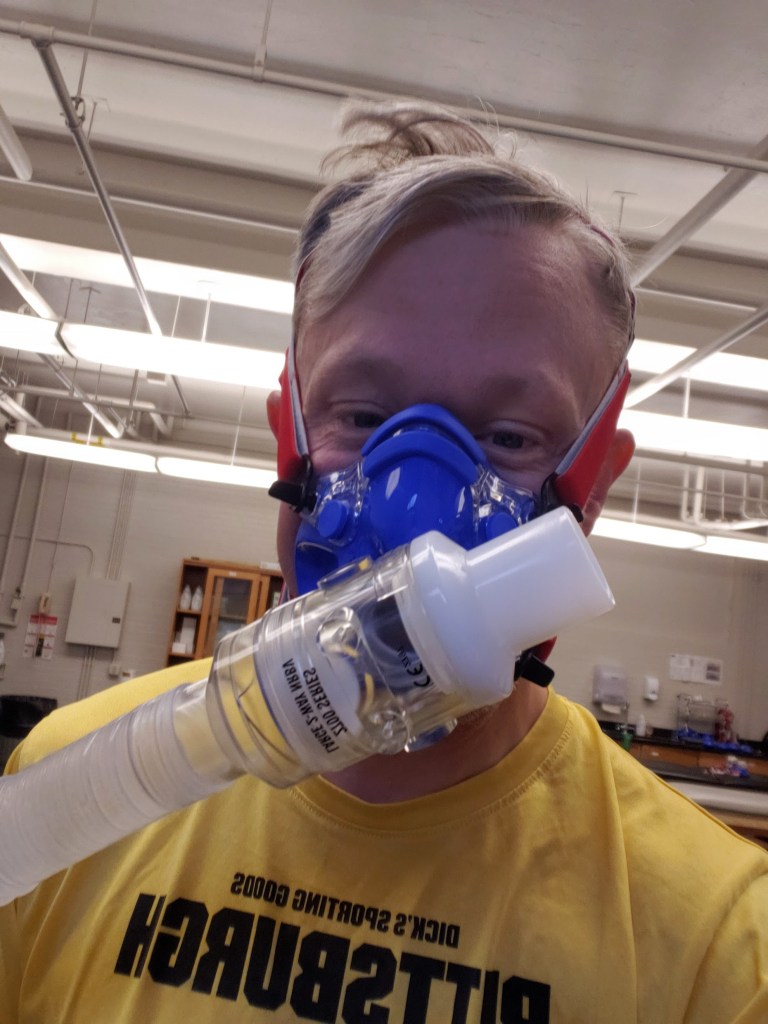
I’m about to run a half-mile as fast as I can, have some blood squeezed out of me, and then do it five more times.
I’m smiling because once that final interval was run, I was free. Free to eat pizza and bananas and all the Little Debbie Christmas trees I could fit in my face.
In this selfie, I’m on a treadmill in a Grove City College lab for my final round of testing as part of a three-month study. After a month on a high-carb diet, a month off, then this final month of the super-low-carbohydrate keto diet, the mask and attached tube would help measure how much air I was pulling in, how much oxygen I was processing, and how efficiently. The blood samples between each round were to look at things like blood lactate, a byproduct of anaerobic exercise, or what happens when your body can’t keep up with the oxygen demands of what you’re putting it through, like mostly sprinting half a mile; and ketones, or what’s created when your body burns fat for energy while in ketosis.
The doctors running the trials are taking a closer look at what’s become somewhat of a consensus with regard to the keto diet.
For this version of the diet, I had to live off a maximum of 50 grams of carbs a day, or about two bananas. Normal humans burn carbohydrates for the fuel to run, walk, live, but if you restrict your carb intake enough, you can force your body to burn fat instead. The current consensus, basically, is that fat is an inferior fuel for high intensity exercise. Other studies of runners have found that fat’s not too bad under easy paces, but once you kick it into that higher gear, you lose power.
These docs don’t think that’s necessarily the case. And apparently, my early results back that up. After a full month of the high-carb diet, my mile time was around 6:48. Which, I didn’t know I could do. After a month of spreading out the amount of carbs I had been eating in one day across an entire week, I was at 6:51. For me, still not, too shabby, and not a major difference.
Most people don’t really care about what your mile time is after a month of keto, they want to know about the weight loss.
So, I didn’t go into this looking to lose weight. After my big initial weight loss of 50 pounds about seven years ago, I’d only gained back about 10 of it. I felt pretty comfortable.
Even on the high-carb diet, just keeping track of my calories while maintaining roughly the same amount of miles per week (around 40) I lost about 10 pounds. Without really trying.
People who have lost weight can tell you that it’s not easy to lose 10 pounds, but it’s even harder to lose the next 10 pounds. Which is what happened on keto.
Again, I wasn’t trying to lose weight. I wasn’t striving for any big calorie deficit. I wasn’t hungry. But over that 35 days of keto, I lost 10 pounds. I went from about 160 to about 150, and was down to 12 percent body fat. If I wasn’t full-blown Protestant, I’d probably post some shirtless pics, because it’s probably never getting any better.
That being said, for me, it wasn’t worth it. I’ve always struggled with weight a bit because food makes me happy. Over the last several years, I’ve worked really hard to find foods that are healthy, while still making me happy, and not being able to have any bread, any pasta, most fruit, even some vegetables, I wasn’t happy. Or, at least not as happy as normal.
As one example, from my niece’s birthday party of pizza and cake — two of my favorites — I had to excuse myself so I could go grab some health food: a bunless Whopper from Burger King.
Most dinners were sausage or hot dogs and sauteed onions and peppers. Everything cooked in a lot of butter (The key to keto, in addition to restricting carbs, is eating a lot of fat. My fat intake was roughly 75 percent of my total calories). Every snack was cheese (most Swiss has no carbs). And basically every breakfast was eggs.
I was eating hamburgers, hot dogs, sausage and bacon and losing weight. Which I bet for some people sounds amazing, but it’s not.
My guts didn’t feel amazing. And my running suffered. A lot of days at mile three or so, I’d get too nauseated and have to walk for a bit. Not ideal.
As soon as that morning of testing was done, I literally went up the street to grab a Little Ceasers’ Hot & Ready pizza, a couple pops, some Doritos and some Little Debbie Cupcakes, and ate nearly all of it, as I drove home in a rush to get to my first meeting of the day. That kind of desperation is not manageable.
So, for me, bottom line, keto can definitely work. But it’s also definitely not worth it.
The doctor I worked with got it. He suggested instead of limiting myself to 50 grams of carbs, maybe try 100. So, here, after the holidays, I’ll do some experimenting. Keto isn’t fun, but now that I’m the leanest I’ve ever been as an adult, I’m also running faster than I ever have, which is pretty fun.
Here’s hoping for balance in 2022.
 Have you thought about this?
Leave a comment